Zalando · Jan–Apr 2025
Zilkroad
Two days before departure, leadership decided the designer needed to be in the room. I flew to Shenzhen with no written brief and shaped the work once I arrived.
Context
The same design vocabulary means different things here
Zalando had opened its first office outside Europe in Shenzhen, a deliberate bet on cross-pollination between the European and Chinese markets. Two days before the team flew out, leadership decided they needed a designer in the room. I flew out with no written brief and shaped the work once I arrived.
IDEO, a global design firm, had run the first phase of research in Shanghai. They found that customers collect fashion inspiration from Instagram and Pinterest but have no way to act on it inside Zalando. I came in to lead the second phase and make it tangible.
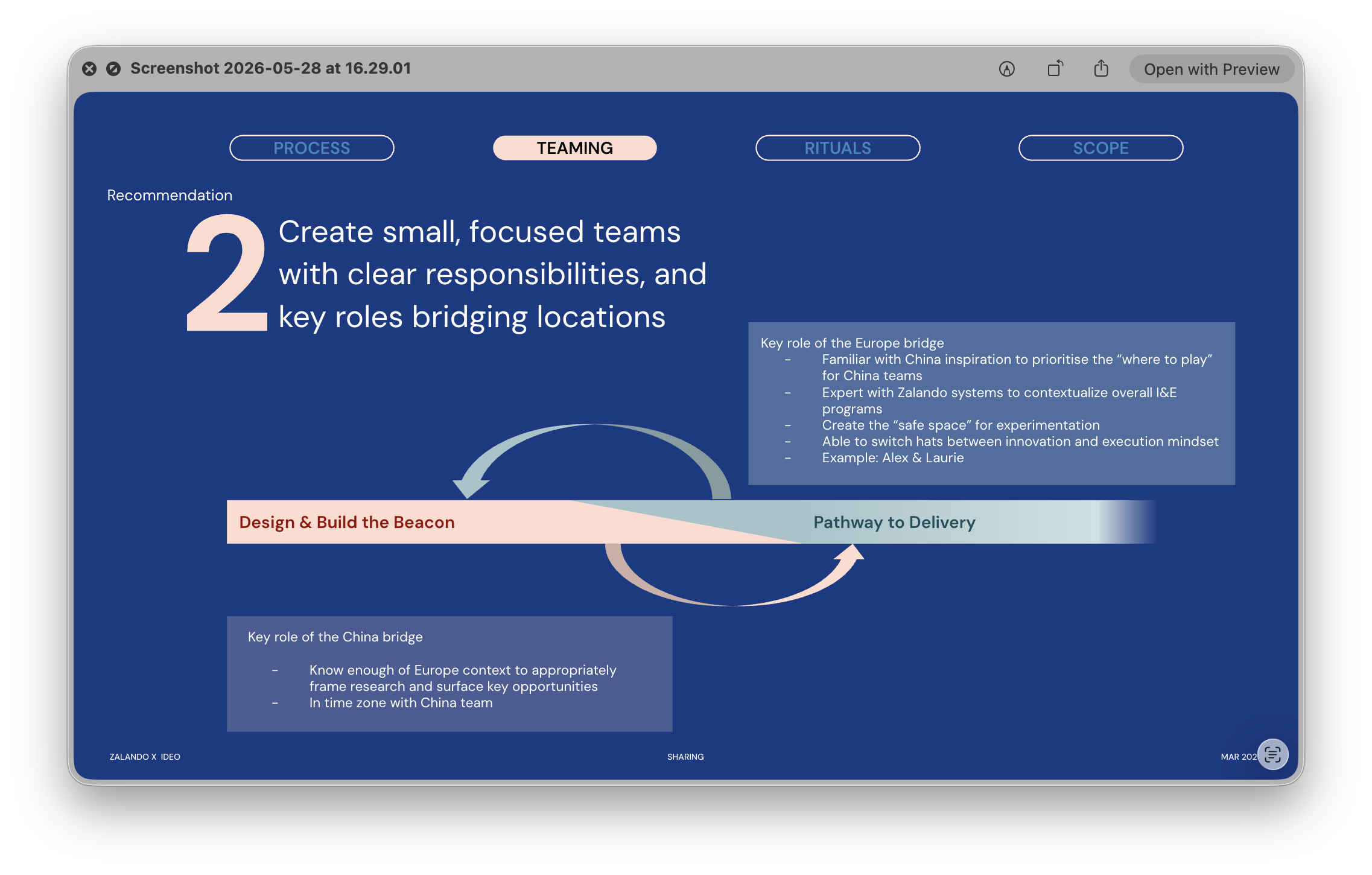
I had to learn fast that Chinese and European commerce do not share the same design logic. I saw that red often reads as gains there rather than a warning, and that a dense interface can signal trustworthiness rather than clutter. I could not lean on much of what eight years of European product work had taught me. So I built the project structure, the cadences, and a shared vocabulary from scratch. Berlin and Shenzhen kept those patterns as the template for the design collaboration that followed.
Visual inspiration search
The hard question wasn't the interface
The interface was never the hard part. I had to decide which Chinese social commerce patterns were worth bringing to Zalando in Europe. I ran a set of sacrificial concepts and a stakeholder workshop, and narrowed the field to one: visual inspiration search.
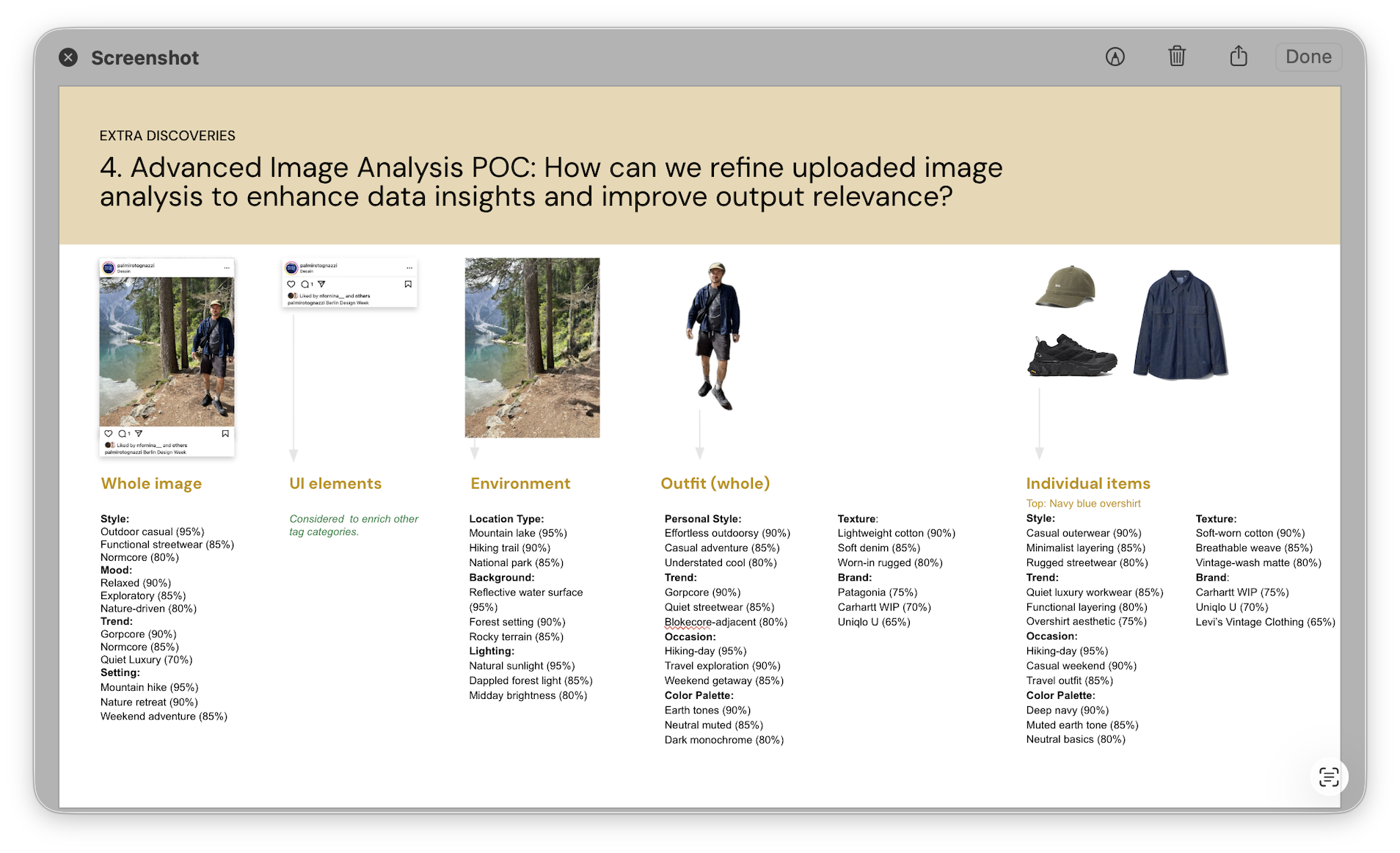
I defined how the model should read an image: the whole composition first, then the subject, the background, the outfit, and the individual items. I designed and tested the taxonomy underneath, the tags and categories that make those readings useful rather than literal. I learned from the testing which tags earned their place: customers valued style and trend tags most, and chose confidence-ordered tags most often in the top two positions. Engineering handled the integrations.
What the research showed
22 participants, two AI tools, one hard requirement
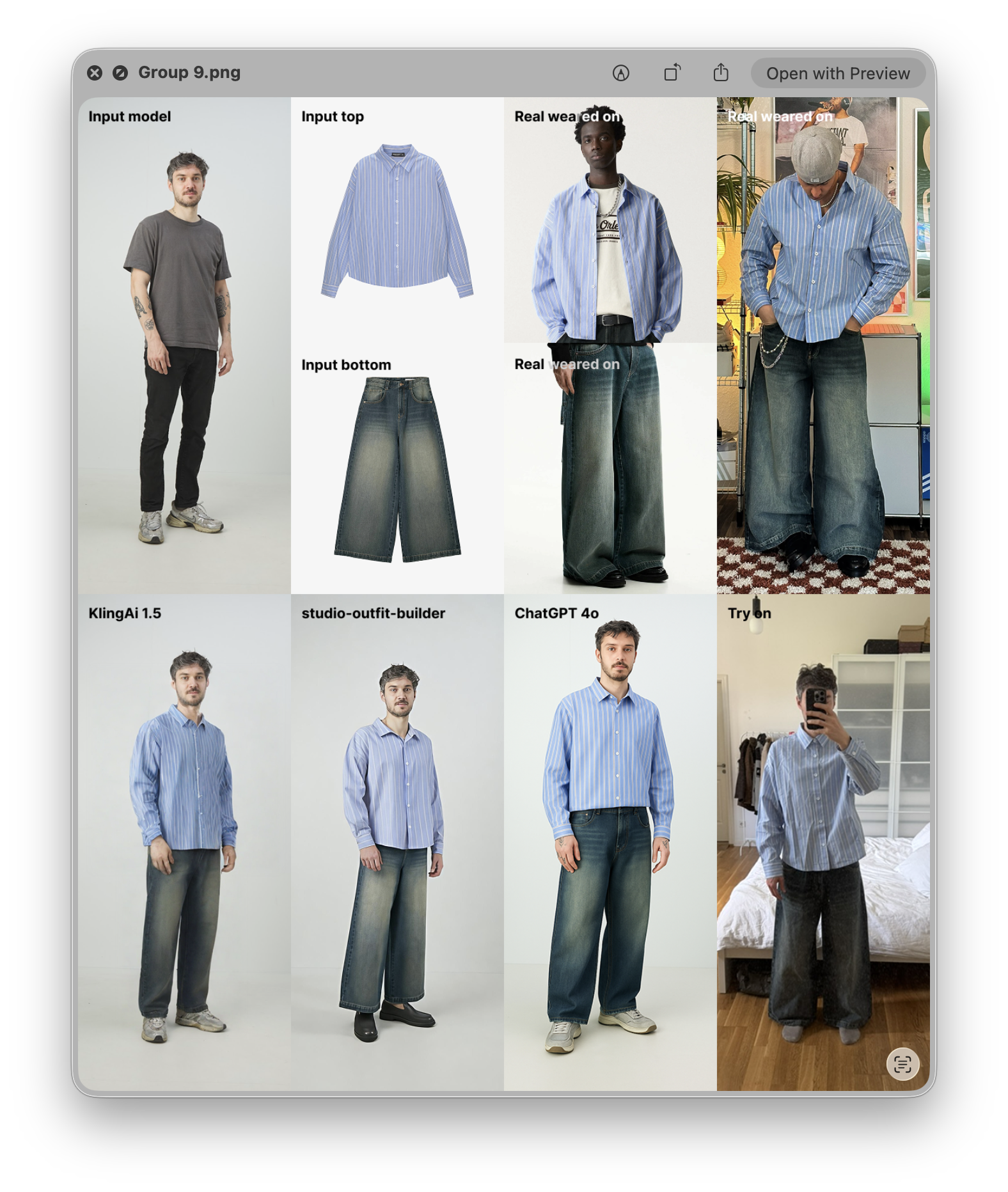
To validate the virtual outfit generation, I ran a structured experiment with 22 participants and more than 50 image uploads. I stress-tested two AI image-generation tools, KlingAI, a Chinese model, and Style-It, for outfit accuracy across wide, normal, and tight fits, and across patterns and prints. Customers fell into the uncanny valley whenever an avatar was AI-generated. Real Zalando models became a hard requirement after that, not a preference.
Out of the research I drew two principles and carried them into the spec. With Always Fresh, I had the system learn from every upload, not just the last one. With Getting to Know You, I made the personalisation compound with each photo a customer adds.
I kept the pilot simple: upload a photo, get a Zalando outfit inspired by it. Zalando is about to release the full feature.
Handover
Built to be handed over
I onboarded the responsible product teams, wrote the handover documentation, and left. I had built Zilkroad to be handed over, not to keep. The teams carried the attribute extraction into content discovery, and Zalando built its "What Should I Wear" feature on the outfit generation.
I left one thing unfinished: too many teams, too many surfaces, and no single owner for the biggest opportunity in the product. I took that on next, and it became Occam.